Hey there non-Finnish technical content creator!
15.05.2024 | STVY | Blog
You bravely decided to move to Finland and there might plenty different reasons why you did. The nature is beautiful, the people are friendly. You feel that this is the place for you. Clean, fresh air enters your nose and lungs, and you feel calm. Drastic reality check: the bills need to get paid so it’s time to look for a job. Your Finnish language skills are either nonexistent or the opposite – very good. The bottom line is that for the job you might be after, you need to have skills to write technical texts in Finnish.
Maybe you already got your foot in the door of technical communication and want to change the workplace. Or perhaps you are still looking for that dream job where you would be fully accepted and valued with your imperfect Finnish language skills. Either way buckle up! The road to finding that great place is going to be bumpy!
Accidental beginning
Thinking about childhood, I don’t think any of us answered “I want to write documentation” when we were asked “who do you want to be when you grow up”. Based on my discussions with fellow technical writers and stories I heard over the years, it would appear that most of us got into this field by accident. That certainly happened in my case. I first set foot on the cold ground of Finland in January 2010. In November 2009, I had this crazy idea that I want to spend a semester studying abroad. Luckily, a few places were still available at that time of year. Possible choices included Finland and Grand Canaria, Spain. Do not ask me why I chose the eternal winter, ruisleipä, and more than 50 different terms to describe snow over sunny beach, warm sea, and umbrella cocktails with spectacular sunsets. I think it had something to do with the language of the university courses, but still Justyna, really? Like almost every exchange student I took an introductory course in Finnish and already then it was quite obvious that it is NOT an easy language to learn.
Towards the end of the exchange, I was desperately trying to grab any opportunity to be able to stay in Finland. But as my university did not approve me continuing my studies in Finland, I had to go back to Poland. I did, however, manage to get a place in a Finnish Polytechnic. So, for two years, I continued to double degree with lots of traveling between Poland and Finland. In 2012 I moved to Finland with a plan to build my “adult” life here. I had a very limited knowledge of Finnish language (maybe lower end of the A1 level) but it felt like my educational background was quite solid.
Looking for the first job
Soon after settling in, I started to look for a job. I knew I did not want to become a programmer. I was after any other job remotely related to any of my skills. And there it was: a job ad for a “technical writer”. It did not sound overly exciting, but it matched my profile. I applied and after the job interview, I was offered the position. I remember thinking to myself “writing manuals – what a boring job.. but it will get the bills paid and I can continue searching for a better job”. So I took it.
Within a few months I realized that this job was actually quite cool. I always thought that because the user manual includes parts from different areas of expertise, I am the most important person in the center, connecting various specialties into one coherent instruction. A person that has the most general knowledge about the product. A person that possesses the most important information about mechanics, electronics, software, and product maintenance. In that workplace, it didn’t matter that I didn’t speak any Finnish. The company’s official language was English, and I only wrote content in English since most of the business was done internationally. Since everyone spoke English so well, I didn’t even bother to learn Finnish. Sure, I took some courses but the motivation to learn it at a good level was medium at best. My situation drastically changed in 2015 when I left my job and started to look for a new one. I was fairly confident that I would find a new job quickly. Unfortunately, that was not the case. I was unemployed for 3 years. Now why was it so difficult to find a new job as a technical writer? Let’s dig deeper into possible reasons.
Language skills
First of all, a lot of documentation job ads very clearly stated candidate requirements such as “Ability to produce content in English”, “Finnish language skills not required but will be seen as benefit”, “Main tasks include writing user documentation in English”. However, often when I got to the job interview phase and didn’t get selected, upon asking the recruiters for a reason, I wasn’t getting a very clear answer. What I heard was “Yes, we write the documentation in English, but the company’s language is Finnish”, “A good fit for this position has to be able to write technical texts in Finnish, just in case that is needed”, “We may have a need for some Finnish translations at some point”. Looking back at those answers makes me think “is it really impossible in a company full of native Finnish speakers to find a person who can translate few things into Finnish if the need arises?”.
It seemed that my job search was going nowhere. We struggled financially, and I considered changing the career path I was passionate about. None of the rejection answers I got during my 3 years of job search were reasoned with lack of technical skills, poor communication skills or any other non-language related reason. It always boiled down to lack of Finnish language skills. I started to study Finnish with accelerated speed. I knew I wouldn’t reach a near-native level at any time in next 5, 10 or even 20 years but I realized that if I want to find a good and satisfying job in the field of technical communication, I cannot get by with English only. What about other competences?
To DITA, or not to DITA
Another aspect of looking for a technical writer job is your knowledge of technology. User documentation is produced in almost every company, regardless of the product sold or developed. Some of the companies create content using our good, old friend Microsoft Word. If that is the case for the open job ad you are applying for, you are golden. The trend, however, seems to be shifting towards the use of structured documentation models such as DITA and LwDITA. Depending on your educational background you might or might not have heard about such models before. It is definitely not without relevance whether you have experience in authoring structured documentation. More knowledge and expertise in technology and tools can help you outshine that tiny language insufficiency you might have. I know learning new things might feel scary and difficult at times, but I think it’s worth the trouble if you really consider a career as a technical writer. How about educational background?
Foreign diploma
You might for example have an English language degree. You might have studied Engineering. I have a Bachelor’s degree in Software engineering from a Finnish Polytechnic and a Master’s degree in Computer Graphics from a Polish Technical University. Unfortunately, sometimes I was getting a feeling that my Polish Master’s degree was a question mark for many recruiters and often, they weren’t particularly interested in hearing about it. Interviews became livelier when I mentioned that I also have a Bachelor’s degree from a Polytechnic in Finland. Only then would I be asked about the courses I completed and occasionally about my thesis topic. Could it be that our degrees from our home countries are often seen as less valuable than degrees earned in Finland? But let’s talk about those job interviews.
Job interviews
Have you ever been invited to a job interview and feared it would be in Finnish? I have. Some companies would even send an invitation in Finnish to which I had to respond in Finnish. With my limited Finnish language skills, I didn’t want to make a bad impression right away, by responding to the interview invitation with a message full of spelling and grammar errors. Luckily, my Finnish husband proofread my messages before I sent them. So that part was covered.
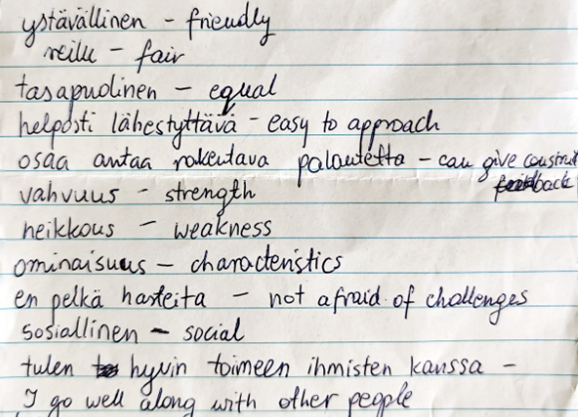
But what about the actual interview? I did not feel confident enough to carry out a job interview in Finnish. At that time, I could barely manage simple daily communication, let alone the technical details of documentation technologies. I didn’t see any other option, so I prepared in the only way I saw possible. I listed the most common job interview questions and memorized answers to them in Finnish. We practiced a lot with my husband. He asked me the same questions in different ways, and I tried to answer and memorize key vocabulary. “Tulen hyvin toimeen ihmisten kanssa”, ”oma-aloitteinen ja täsmällinen persoona” or ”en pelkää haasteita” were only a few of the expressions that made it to my list.
I spent so much time on preparing those answers, that I decided to keep them “just in case”.
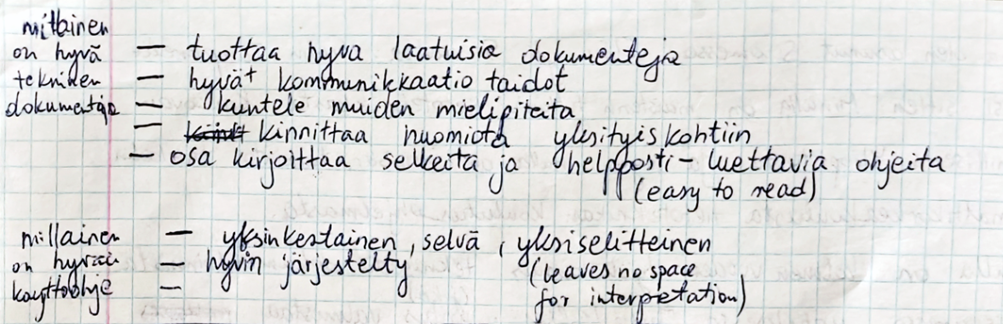
A small part of my extensive list with a job interview related words and phrases.
I know what you are thinking. Is it even possible to prepare for every possible question asked in every possible way? No.
Did I sound natural in those job interviews? No.
But did I come out successful on the other side, getting a job resulting from a job interview in Finnish? Also no.
The difficulty lies in presenting yourself and your strengths in a language that you don’t know well. My point of view? If a hypothetical recruiter doesn’t see your butchering Finnish as a sign of courage and great effort in trying, they will hear all the grammar errors, wrong endings, and lots of pauses in the sentences and there is no way that will present you in a good light.
Are we doomed to fail?
Not at all. Many people have shown that it is possible to build a successful career as a technical writer regardless of the level of Finnish in their pocket. As foreigners who immigrated to Finland, we often struggle to find a job. Therefore, once we get one, we are often prepared to prove our worth beyond expected levels and give that extra effort in our tasks. We have plenty of strengths to advertise: we can adapt to new situations, we are brave, we spend time on learning new skills and polishing the existing ones to raise our chances of getting a job. We are ready to show you that you made the right decision to hire us and give us this chance.
I am happy that I didn’t give up when it seemed like I wouldn’t be able to find another job as a technical writer. I am glad I stuck through the hours of studying Finnish and trying to understand often confusing Finnish language grammar.
All hope is not lost
I want to leave you with words of encouragement.
It only takes one workplace to recognize your true potential and strength for them to offer you that long-sought job. It only takes one recruiter to understand it doesn’t matter that you might never speak or write fluent Finnish. It only takes one job interview with your skills outshining the language aspect so much it won’t even matter. It does, however, take the whole work community to support you and let you in regardless of the level in Finnish that you bring to the table.
Will you have meetings held in Finnish where you won’t understand anything? Yes.
Will you have onboarding in Finnish? Maybe.
Will you have to get your documentation content from a person who speaks only Finnish? Possibly.
But will you learn tons in the process? YES.
Will you start recognizing the words and phrases as the time goes by? YES.
Will you eventually feel like a full member of the work community regardless of your language skills?
You will.
Finnish people are amazing in how well they can adapt and help you with your Finnish language skills. I am still grateful to people who refused to speak English with me from the very beginning even though they could, since they wanted to encourage me to learn Finnish. I am grateful for friends I have made in my new workplace who can only speak and understand Finnish. Those kinds of situations forced me out of my comfort zone and pushed me to try. I am sure that I still make lots of mistakes when I speak Finnish. And maybe so are you. But that’s ok because in the end it’s people who matter the most and some people will make that dream job happen to you too.
– Justyna Hietala, Senior Designer and Team Lead, Technical Documentation